4 min readFree
Class 1 and Class 2 land meaning in Maharashtra
Class 1 (वर्ग-1) land can broadly be sold freely. Class 2 (वर्ग-2) needs government permission to transfer. Here is where to read the class on the 7/12 and what tribal-land rules add.
Key points
- Class 1 (भोगवटादार वर्ग-1) land carries broadly unrestricted rights of transfer, while Class 2 (भोगवटादार वर्ग-2) land is subject to restrictions and usually needs prior government permission to transfer.
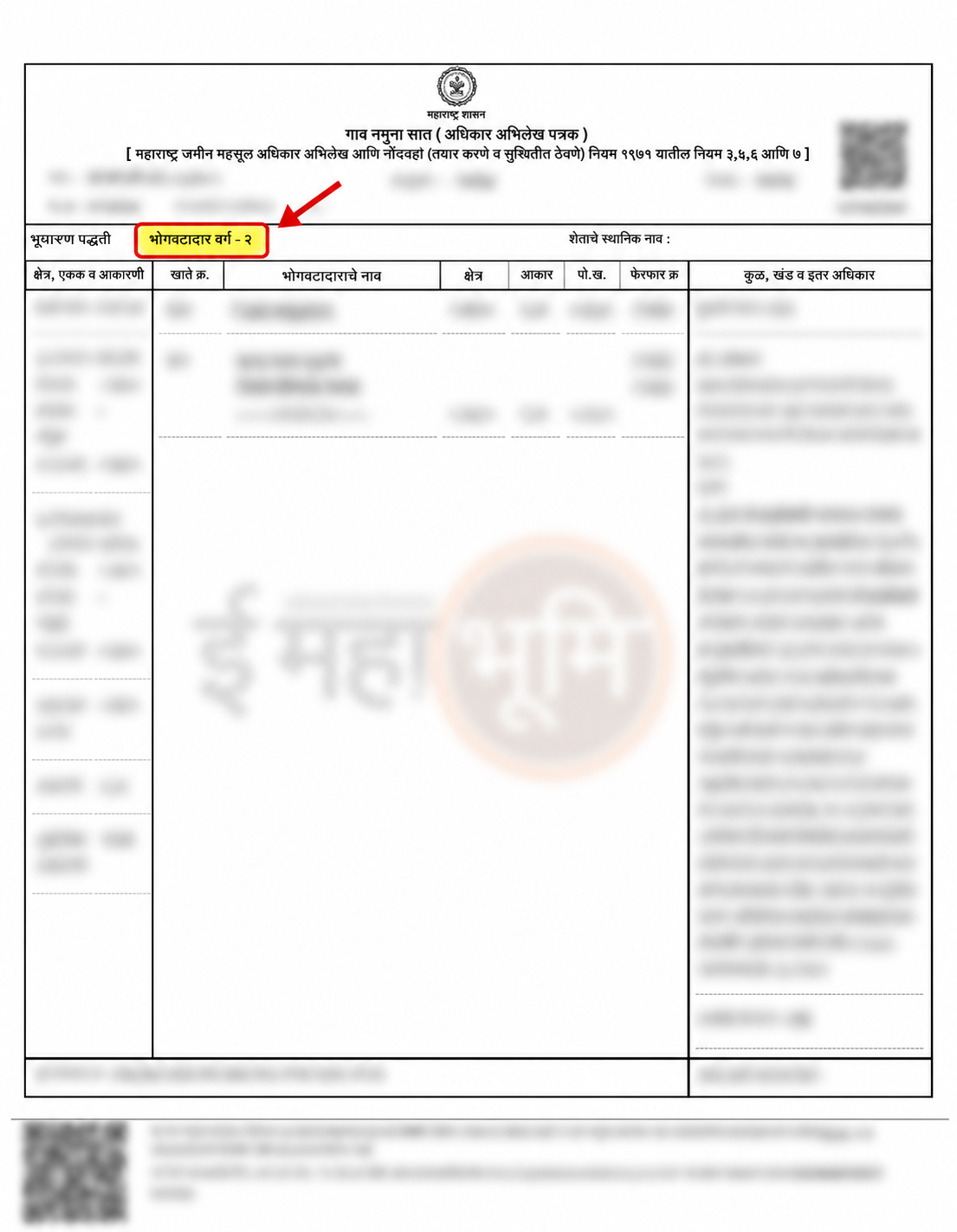
- The occupancy class is printed on the 7/12 extract next to the occupant's name. Read it on the current 7/12 before paying any advance.
- A Class 2 sale without the required permission is not a paperwork defect. It can be void, and the buyer's payment does not cure a missing sanction.
- Under section 36 of the Maharashtra Land Revenue Code, 1966, an occupancy held by a Scheduled Tribe member cannot be transferred without the Collector's previous sanction.
- Where a seller says Class 2 land was converted to Class 1, ask for the conversion order and the amended 7/12 rather than accepting an assurance.
Class 1 and Class 2 land in Maharashtra: the two classes
Class 1 and Class 2 land in Maharashtra differ on one point that decides a sale: whether the holder may transfer the land without asking the state. The Maharashtra Land Revenue Code, 1966 classifies holders of land. An occupant Class I (भोगवटादार वर्ग-1) holds land with, broadly, unrestricted rights of transfer. An occupant Class II (भोगवटादार वर्ग-2) holds land subject to restrictions.
Class 2 land typically reached the holder through a government grant, land-reform distribution, tenancy legislation or similar routes. Transfer then needs prior government permission, and often a payment (nazrana) to convert or transfer. There is also government-leased land, where the holder is a lessee of the state.
Where the class appears on the 7/12
The class is written on the 7/12, next to the occupant's name. It is one of the first things any screening reads.
To check it, follow these steps:
Get the current 7/12 for the survey or gat number, not an old copy.
Find the occupant's name and the class beside it.
Read the इतर हक्क (other rights) column for grant conditions, loans and other entries that qualify the class.
The guide to occupancy classes explains which grants need the Collector's permission before transfer.
Why वर्ग-2 changes everything
A sale of वर्ग-2 land without the required permission is not a paperwork defect. It can be void, with the land liable to consequences under the conditions of the original grant. The buyer's money and the seller's signature do not cure a missing sanction.
Maharashtra has a route for converting eligible वर्ग-2 holdings to वर्ग-1 by paying the prescribed premium under government rules. Where a seller claims conversion, the proof is the conversion order and the amended 7/12, not an assurance.
Tribal land: MLRC sections 36 and 36A
Separately from the class system, the Maharashtra Land Revenue Code, 1966 restricts transfers of land held by Scheduled Tribe members. Section 36(2) says such occupancies cannot be transferred except with the previous sanction of the Collector. Section 36A adds that the Collector may not grant that sanction unless satisfied that no tribal living in the village, or within five kilometres of it, is ready to take the land on lease, mortgage or sale.
In villages in Scheduled Areas, the state modified section 36A in a notification dated 14 June 2016 so that the Gram Sabha's prior sanction is also required.
A transfer made in breach can be undone. Under section 36(3), the tribal transferor or an heir may apply to the Collector, within thirty years of the transfer of possession, to be placed back in possession. The mode of transfer does not matter: a Bombay High Court headnote records that a transfer in violation of section 36A is invalid and of no legal consequence. A purchase that ignores these provisions buys litigation, not land.
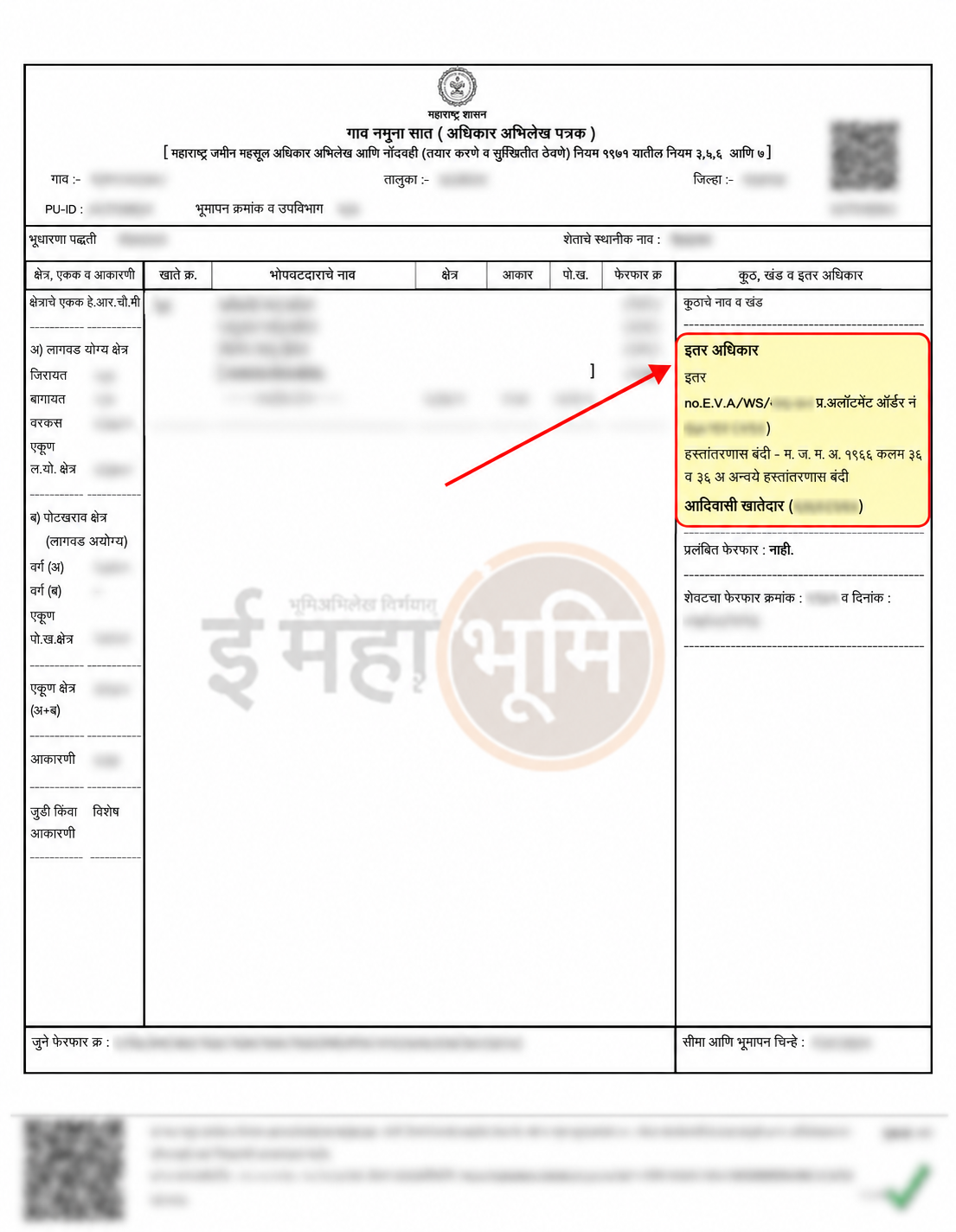
The 7/12 and mutation history usually reveal the trail: the holder's status, how the land was acquired, and any earlier sanctioned or unsanctioned transfers.
What a buyer should do
Check the class on the current 7/12. If it is anything other than plain वर्ग-1, treat the transaction as conditional until the permissions and orders are in hand and verified. This is precisely a question for a licensed advocate. The screening's job is to make sure it gets asked before the advance is paid, not after.
Every LandSahi report, Snapshot included, reads the current 7/12 and flags वर्ग-2 and grant conditions, nazrana conditions and tribal-holder entries. The occupancy class is one part of verifying a land title in Maharashtra, and the sample report walkthrough shows how a report sets out what it found.
Questions this post answers
- What is Class 1 (वर्ग-1) land in Maharashtra?
- Class 1 land is land held by an occupant Class I (भोगवटादार वर्ग-1) under the Maharashtra Land Revenue Code, 1966, with broadly unrestricted rights of transfer. The class is written on the 7/12, next to the occupant’s name.
- What is Class 2 (वर्ग-2) land in Maharashtra?
- Class 2 land is held by an occupant Class II (भोगवटादार वर्ग-2) under the Maharashtra Land Revenue Code, 1966, subject to restrictions on transfer. It usually reached the holder through a government grant, land-reform distribution or tenancy legislation, and transferring it needs prior government permission and often a payment (nazrana).
- Can वर्ग-2 land be sold?
- Only with the prior government permission its grant conditions require. A sale without that permission can be void, and the buyer’s payment and the seller’s signature do not cure a missing sanction.
- Where is the occupancy class shown?
- The occupancy class is shown on the 7/12 extract, next to the occupant’s name. Class I (वर्ग-1) means broadly unrestricted rights of transfer; Class II (वर्ग-2) means transfer is restricted.
- Can वर्ग-2 land be converted to वर्ग-1?
- Eligible holdings can be converted by paying the prescribed premium under government rules. Where a seller says the land was converted, the proof is the conversion order and the amended 7/12, not an assurance.
- What do sections 36 and 36A of the Maharashtra Land Revenue Code restrict?
- They restrict transfers of occupancies belonging to tribals. A transfer to a non-tribal needs the Collector’s previous sanction, and a transfer made in breach can be undone.
Sources
- Section 36(2) · indiacode.ecourtsindia.com
- notification dated 14 June 2016 · rajbhavan-maharashtra.gov.in
- section 36(3) · lextechsuite.com
- Bombay High Court headnote · nearlaw.com
Written by Dhruvin Sanghvi, Co-founder
General information, not legal advice. A legal opinion on title needs a licensed advocate.
New posts, by email
One email when a post goes up, in English or Marathi. Every email has a one-click unsubscribe.